 IonWarp
 for Claude Code
Claude Code PR review that hands every finding back to Claude
If Claude Code writes your pull requests, IonWarp reviews each one on GitHub and turns every finding into a prompt Claude can act on. We work this way ourselves. In the week of November 10, Claude opened 264 pull requests in our repositories that we went on to merge, and IonWarp found at least one issue in 245 of them.
14 days free, no cardPro is $49/mo for 5 seatsNever pushes to your branch
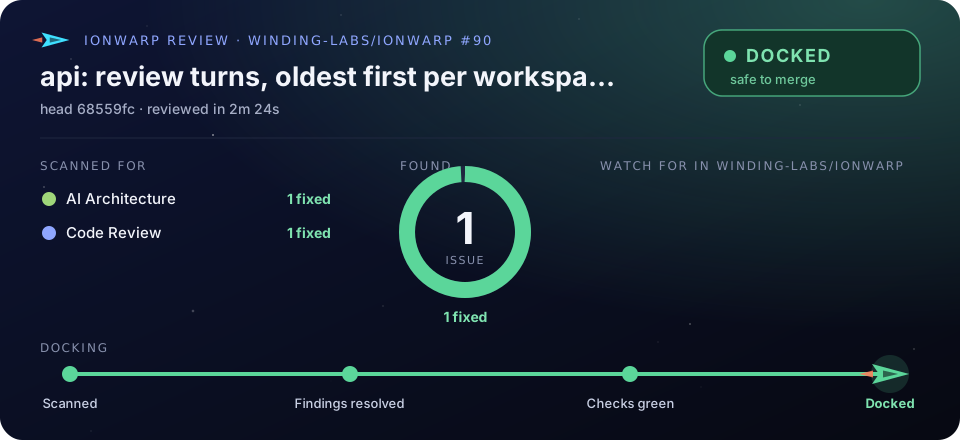
What IonWarp found in 264 of Claude’s pull requests
Between November 10 and 16, 2026, IonWarp reviewed 264 pull requests that Claude Code opened and we later merged, across five of our repositories. We counted everything below from its comments on GitHub on November 17.
| Pull requests with at least one finding | 245 of 264 (92.8%) |
|---|---|
| Findings in a typical pull request | 3, the median |
| Pull requests with at least one P1, a finding that should be fixed before merge | 94 (35.6%) |
| How long a review took | 3 minutes, the median |
| Which agents raised the 1,303 findings | Code Review 482, AI Architecture 394, Docs Review 158, API Performance 99, Security Review 64, SOC 2 Review 57, and 49 from the other agents |
The P1s are the part we’re least proud of. Of 127, 31 were fixed and 20 more were answered with a reason for leaving them. The other 76 merged with neither. IonWarp lets that happen, because a P1 leaves the check Neutral, which GitHub counts as passing. Only an open P0 makes it Action required.
One habit stood out. In the 71 pull requests that got an IonWarp autofix round, 35 of 58 P1s were fixed or answered (60.3%). In the other 193, only 16 of 69 were (23.2%). The samples are small, so take this as a direction rather than a result. Still, it’s why the loop below has Claude answer each finding by id instead of leaving the review for someone to read later.
How the loop runs
- Claude Code opens the pull request. If your CLAUDE.md asks for it, Claude also adds IonWarp’s session analytics block to the description. The block names the coding agent and how long each step took.
- IonWarp reviews it. The agents you’ve switched on go through the change. IonWarp puts each P0 and P1 on its line, then posts its review and an IonWarp / Review check on the pull request. Code Review traces each changed function to its callers. AI Architecture flags duplicate code, second code paths and code left behind, and in our sample only Code Review raised more findings.
- Claude reads the fix prompt. Every finding comes with one, and the check’s output gathers all open P0s and P1s into a single prompt. Claude can fetch it with the GitHub CLI, so nobody has to paste it in.
- Claude fixes, pushes and answers. It posts one IonWarp autofix round comment that answers each finding by id as Fixed, Wontfix or Skipped. A Wontfix dismisses the finding right away, and the next review checks whether each Fixed claim holds.
- What’s left goes on the To-do. Add to To-do puts a finding on the project’s IonWarp To-do issue on GitHub. Hand to Claude does the same and also comments @claude with the finding’s prompt. If your team runs the Claude GitHub app, the app picks it up and opens a new pull request for you to review.
Put these lines in CLAUDE.md and Claude runs the loop without being asked:
## IonWarp
After you open or push to a pull request, wait for the IonWarp / Review check.
Fix each open P0 and P1 it lists if it still holds, push one commit, then post
one IonWarp autofix round comment answering each finding by id.
Format: https://ionwarp.com/docs/fixing-findings#autofix
This one command reads the prompt from the check:
gh api repos/OWNER/REPO/commits/SHA/check-runs \
  --jq '.check_runs[] | select(.name == "IonWarp / Review") | .output.text'
IonWarp never pushes a commit, so every change on the branch comes from Claude or from you. Autofix answers are accepted only from a person with write access, and bot accounts are ignored. Answers Claude posts through your GitHub CLI still count. The details are in Fixing findings.
What IonWarp learns from Claude’s session
Claude can add a YAML block to the description of each pull request it opens. IonWarp uses it to time the agentic loop, from your first prompt to the pull request, next to the CI/CD loop from push to merge. The review log then shows what wrote the change, for example “written in Claude Code (Opus 5) — plan 5m · implement 30m · verify 10m.” The block was on 59 of our 264 pull requests, and the format is in session analytics.
Claude can look things up in IonWarp during a session too. The MCP server has four read-only tools that tell it who you are and list your projects, findings and reviews, so you can ask about findings without leaving the terminal.
IonWarp next to Claude’s own Code Review
Anthropic has its own GitHub reviewer, Code Review in Claude Code. If your organization is on a Claude Team or Enterprise plan and correctness checks are all you need, it’s the shorter path. Here is how the two compare, based on Anthropic’s docs and our pricing page as of November 17, 2026.
| Claude Code Review | IonWarp | |
|---|---|---|
| Who can turn it on | Claude Code Review: A Claude Team or Enterprise organization, after an Owner turns it on.[1] | IonWarp: Any team on GitHub.com. Your Claude Code plan doesn’t matter. |
| What it costs | Claude Code Review: Token usage, billed through usage credits. There’s no flat price per review.[2] | IonWarp: $49 a month per workspace with 5 seats and $25 of review spend, or $149 with 10 seats. The first 14 days are free. |
| What it looks for | Claude Code Review: Correctness by default, tuned with REVIEW.md and CLAUDE.md.[1] | IonWarp: Code Review, Security Review, AI Architecture, Log & Errors, Docs Review, API Performance, SOC 2 Review and CI/CD Performance. A trial started here begins with Code Review and Security Review, and you can switch on the rest. |
| Models | Claude Code Review: Anthropic picks them, and there’s no model setting.[1] | IonWarp: We pick each agent’s model on our public benchmark, taking the cheapest one that clears a quality bar. |
| The check on GitHub | Claude Code Review: Its check run never concludes as a failure.[1] | IonWarp: Action required while a P0 is open, Neutral with a P1, and Success otherwise. |
| Where it runs | Claude Code Review: GitHub, including GitHub Enterprise Server.[1] | IonWarp: GitHub.com, with apps on the web, iPhone and Android. |
Each posts its own check, so you can run both and keep the one whose comments you find yourself acting on.
Sources
- Anthropic, Code Review (Claude Code docs), read 2026-11-17.
- Anthropic, Code Review costs and usage (Claude Code docs), read 2026-11-17.